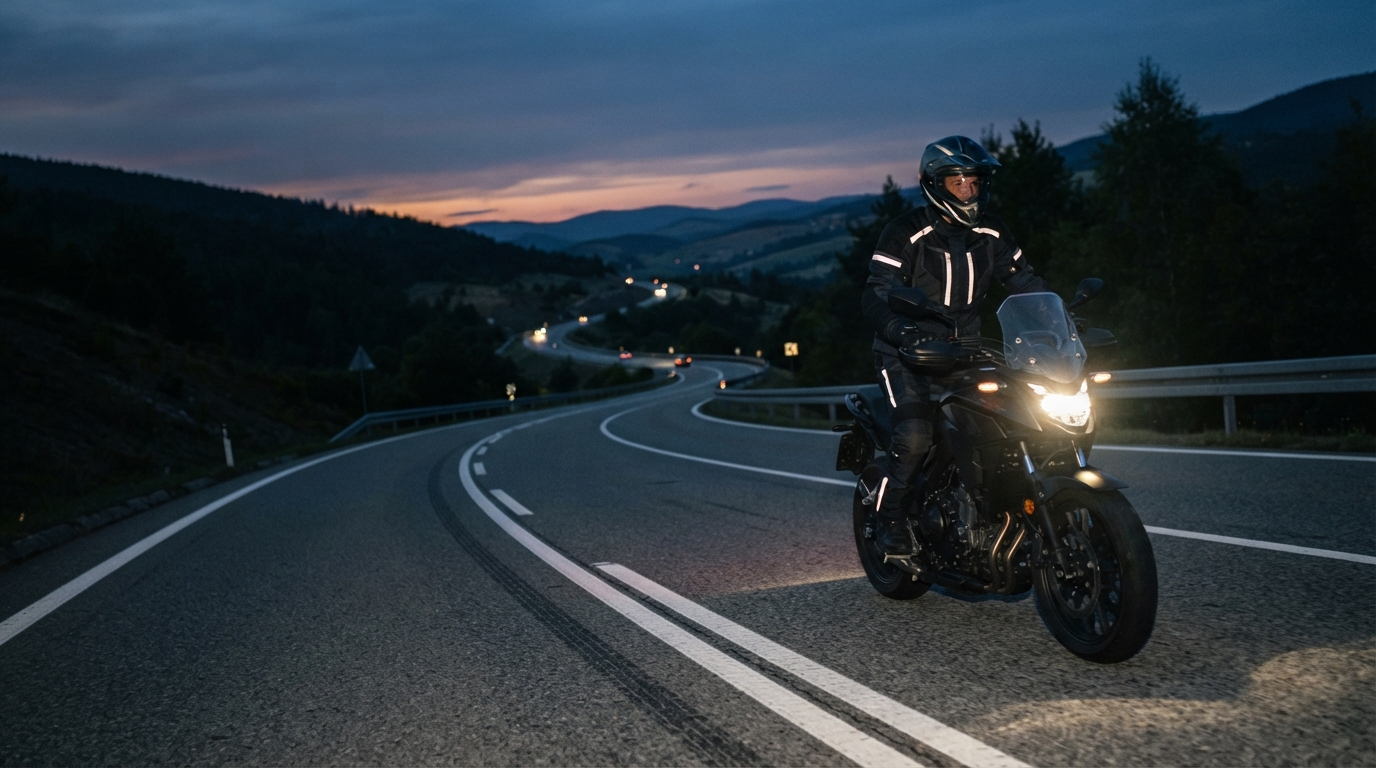
Night motorcycle riding safety requires more preparation than simply turning on your headlight and continuing the ride. Darkness reduces visual information, makes hazards harder to identify, and can make a motorcycle less noticeable to surrounding drivers. At the same time, fatigue may become a bigger concern during late-night and early-morning hours.
A road that feels familiar during daylight can look completely different after sunset. Curves become harder to judge. Potholes and debris may appear later. Animals can enter the road with little warning. Headlights from other vehicles can temporarily reduce your ability to see clearly.
That does not mean riders need to avoid every trip after dark. Instead, night riding calls for a different strategy. Slower speeds, better visibility, more following distance, proper lighting, sober riding, and honest decisions about fatigue can all improve the safety margin.
This guide explains how to prepare yourself and your motorcycle for riding after dark. You can also explore our motorcycle safety tips and motorcycle training resources for more practical riding guidance.
Why Night Motorcycle Riding Safety Requires Extra Attention
Motorcycle riders already have less physical protection than occupants of enclosed vehicles. At night, another challenge is added: limited visibility. Your headlight illuminates only part of the environment, while darkness can hide road conditions, pedestrians, animals, intersections, and other hazards until you are closer to them.
Other drivers may also have more difficulty judging a motorcycle’s distance and speed. A single headlight can provide fewer visual clues than the wider lighting pattern of a passenger vehicle. Therefore, riders should assume that being visible to another driver is never guaranteed.
Current crash statistics also show why after-dark riding deserves attention. IIHS reports that 46% of motorcyclist deaths in 2024 occurred during weekends. Weekend fatalities were more likely to occur after 6 p.m. than fatalities during other parts of the week.
Visibility Changes After the Sun Goes Down
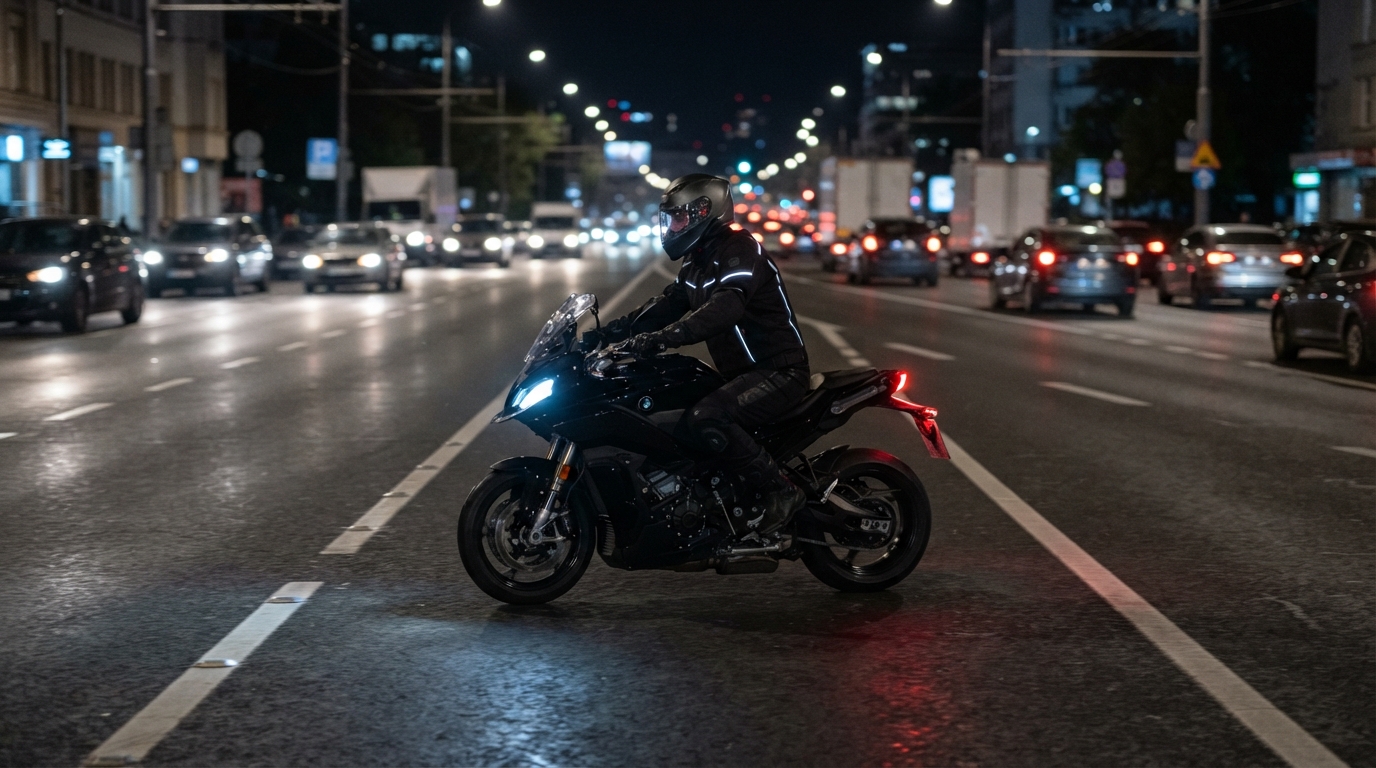
Your eyes need time to adjust as daylight fades. Even after they adapt, darkness reduces contrast and depth perception. A dark object on dark pavement can disappear into the background until you are relatively close.
Glare creates another challenge. An approaching vehicle with bright headlights can temporarily make the road beyond that vehicle difficult to see. Rain can make the problem worse because wet pavement reflects headlights and streetlights.
The solution is not simply installing the brightest possible light. Riders need a combination of functioning motorcycle lighting, clean eye protection, suitable speed, reflective equipment, and active scanning.
Improve your ability to see and be seen
Before riding at night, inspect your headlight, tail light, brake light, and turn signals. Make sure the lenses are clean and the lights operate normally. If your motorcycle has adjustable headlight aim, confirm that it is correctly positioned according to the owner’s manual.
Clean your helmet visor as well. Small scratches, dirt, moisture, and fingerprints can scatter light and increase glare. A heavily tinted visor that works well in bright sunlight may greatly reduce usable vision after dark. Use equipment appropriate for the conditions.
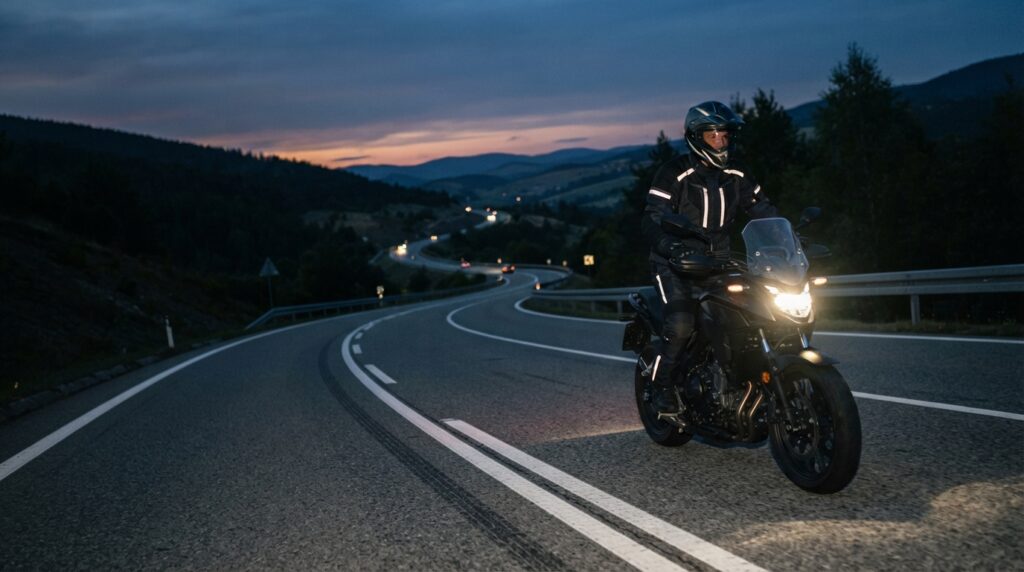
Rider visibility matters too. NHTSA identifies brightly colored clothing and retroreflective material as possible ways to increase motorcycle conspicuity. Reflective areas can be especially useful at night because they return light toward approaching vehicles.
Our motorcycle gear guides cover helmets, jackets, gloves, boots, and other protective equipment that can support both protection and visibility.
Adjust your speed to what your headlight allows you to see
Your stopping distance should fit within the distance you can clearly see ahead. If your headlight reveals a hazard only after you are already too close to stop safely, you may be riding faster than conditions allow.
This becomes especially important on unfamiliar roads. A sharp turn, damaged pavement, stalled vehicle, animal, or object may be hidden beyond the illuminated area.
Reduce speed when visibility decreases. Increase your following distance as well. Leaving additional space behind another vehicle gives you more time to recognize brake lights, changing traffic patterns, and unexpected hazards.
Also avoid staring directly into approaching headlights. Keep your eyes moving and use lane markings or the appropriate side of your lane as a reference while still scanning the road ahead.
Fatigue and Impairment Can Make Night Riding More Dangerous
Visibility is only part of night motorcycle riding safety. The rider’s condition matters just as much.
Fatigue can affect attention, reaction time, decision-making, and coordination. Those effects are particularly important on a motorcycle because maintaining balance and responding to hazards require continuous input.
NHTSA identifies midnight to 6 a.m. as one of the periods when sleepiness can be a particular concern for drivers. Riders should take the same warning seriously. If your normal sleep schedule says you should be asleep, willpower may not be enough to keep your performance at its best.
Alcohol adds another major risk. According to IIHS analysis of 2024 data, 44% of motorcycle drivers killed between 9 p.m. and 6 a.m. had blood alcohol concentrations of 0.08% or higher. The figure was 19% among riders killed at other times.
That comparison does not mean every nighttime crash involves alcohol. However, it reinforces a simple safety rule: alcohol and motorcycle riding should not be mixed.
Recognize when you are becoming too tired to continue
Fatigue does not always arrive as an obvious feeling of falling asleep. It can begin with smaller warning signs. You may miss a turn, stop scanning mirrors, ride inconsistently through corners, forget the last few miles, or repeatedly adjust your posture trying to stay alert.
You may also notice frequent yawning, heavy eyes, slower decisions, or difficulty maintaining a steady lane position.
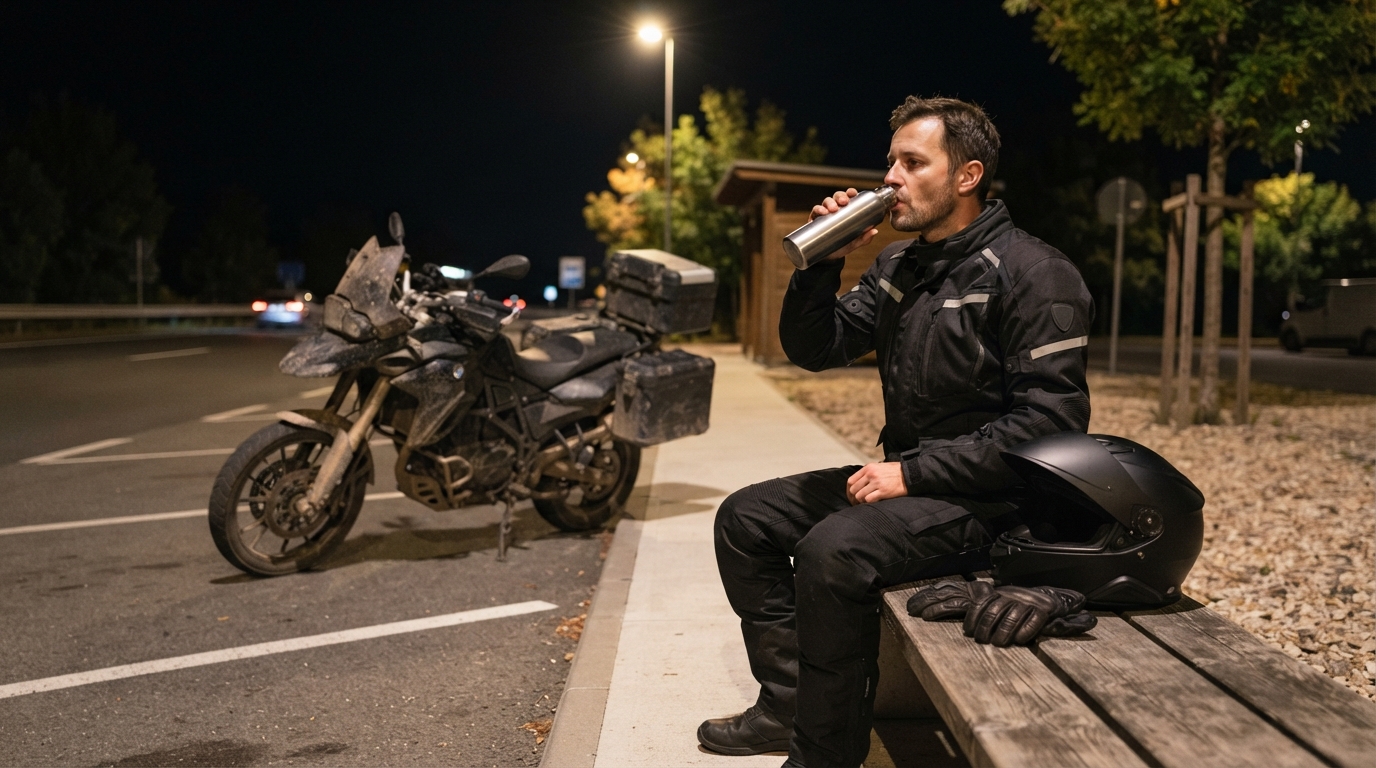
Do not treat these signals as a challenge to overcome. Find a safe place to stop. A short break may help temporarily, but significant fatigue may require sleep or another form of transportation.
Caffeine can make you feel more alert for a period, but it does not replace adequate sleep. Opening a visor, turning up music, or riding faster are not reliable solutions either.
How to Make Night Motorcycle Rides Safer
Preparation can reduce many of the problems associated with after-dark riding. Start before the motorcycle moves.
Check the weather and route. Heavy rain, fog, unfamiliar mountain roads, poorly lit rural highways, construction zones, and wildlife-heavy areas can make a nighttime trip considerably more demanding.
Then inspect the motorcycle. Tires deserve special attention because you may not see surface hazards as early at night. Check pressure, visible damage, and general condition before leaving.
Brake operation matters as well. Make sure the controls feel normal and confirm that your brake light activates correctly. Our training section provides additional guidance on braking and hazard-response skills.
Build a Simple Routine for Every Ride After Dark
Once on the road, actively search rather than simply looking straight ahead. Scan the illuminated pavement, intersections, shoulders, mirrors, and vehicles around you.
Look farther through curves where possible. Watch for reflective animal eyes near rural roads. Be cautious around intersections because a driver waiting to turn may have difficulty estimating your approach.
Positioning can also improve your view. Choose a lane position that gives you useful sight distance while maintaining space from surrounding vehicles. Avoid remaining beside another vehicle longer than necessary because you may be difficult to see in its blind spot.
However, do not assume a particular lane position makes you visible. Drivers can still overlook a motorcycle. Always keep an escape option in mind.
Use this night motorcycle riding safety checklist
- Check the headlight, tail light, brake light, and turn signals.
- Clean your visor and avoid unsuitable dark tint after sunset.
- Check tire pressure and visible tire condition.
- Wear DOT-compliant head protection and appropriate protective gear.
- Add visible or retroreflective elements where practical.
- Reduce speed when your sight distance becomes shorter.
- Increase following distance behind other vehicles.
- Avoid lingering in vehicle blind spots.
- Watch intersections, shoulders, animals, debris, and road surfaces.
- Never combine alcohol with motorcycle riding.
- Stop if fatigue begins affecting concentration or control.
- Use extra caution during unfamiliar late-night rides.
Night riding can also become more demanding in groups. Keep enough space between motorcycles to avoid following another rider’s tail light too closely. Each rider should be able to see the road and react independently rather than relying entirely on the rider ahead.
If conditions become worse than expected, change the plan. Waiting for rain to pass, taking a longer but better-lit route, stopping for the night, or arranging another way home can be a better decision than forcing the original schedule.
For current motorcycle crash information and official safety recommendations, review this motorcycle safety resource from NHTSA. You can also follow our motorcycle news and laws section for new safety information and rider updates.
Night motorcycle riding safety is ultimately about increasing your margin for error. You cannot control every driver, animal, road defect, or lighting condition. However, you can control your speed, equipment, following distance, sobriety, route choices, and decision to stop when you are tired.
Good night riders do not simply try to see farther. They ride in a way that gives them enough time to deal with what they cannot see yet. That combination of visibility, preparation, patience, and alertness can make every ride after sunset more manageable.